
01/11/2025
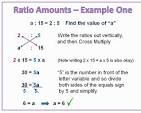
A ratio is a mathematical comparison of two numbers, often written as a fraction or using a colon (e.g., \(3:2\) or \(\frac{3}{2}\)). Ratios show the relationship between quantities, such as the ratio of apples to oranges or the ratio of red to black balls in a box. They can be simplified to their lowest terms and are used to solve problems in many fields. How to write a ratio Use a colon: Write the two numbers with a colon in between, such as \(8:6\). Use the word “to”: Write the numbers with the word “to” in between, as in “eight to six”. Use a fraction: Write one number over the other to show the relationship, such as \(\frac{8}{14}\). How to write a ratio Use a colon: Write the two numbers with a colon in between, such as \(8:6\). Use the word “to”: Write the numbers with the word “to” in between, as in “eight to six”. Use a fraction: Write one number over the other to show the relationship, such as \(\frac{8}{14}\).
22/10/2025
From Wikipedia, the free encyclopedia
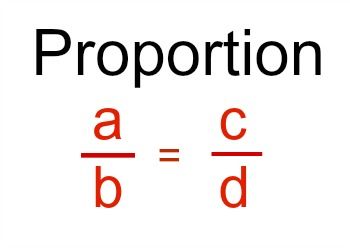
A proportion is a mathematical statement expressing equality of two ratios.[1][2]
a:b=c:d
a and d are called extremes, b and c are called means.
Proportion can be written as ab=cd
Such a proportion is known as geometrical proportion,[3] not to be confused with arithmetical proportion and harmonic proportion.
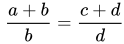
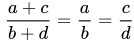
If ab=cd

, then ad=bc
 , then ba=dc
 , then
ac=bd

, db=ca

.
, thena+bb=c+dd
, a−bb=c−dd
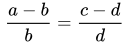
.
, thena+cb+d=ab=cd
, a−cb−d=ab=cd
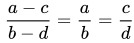
.

 Continue with Google