

 Continue with Google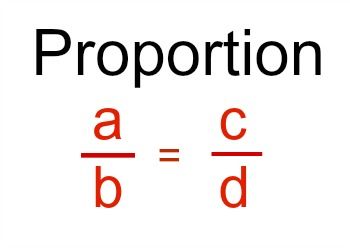
Proportion (mathematics)
From Wikipedia, the free encyclopedia
A proportion is a mathematical statement expressing equality of two ratios.[1][2]
a:b=c:d

a and d are called extremes, b and c are called means.
Proportion can be written as ab=cd
Such a proportion is known as geometrical proportion,[3] not to be confused with arithmetical proportion and harmonic proportion.
- Fundamental rule of proportion. This rule is sometimes called Means‐Extremes Property.[4] If the ratios are expressed as fractions, then the same rule can be phrased in terms of the equality of “cross-products”[2] and is called Cross‐Products Property.[4]
If ab=cd

, then ad=bc

- If ab=cd
- If ab=cd

ac=bd

, db=ca

.
- If ab=cd
a+bb=c+dd
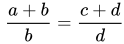
, a−bb=c−dd
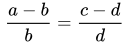
.
- If ab=cd
a+cb+d=ab=cd
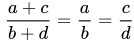
, a−cb−d=ab=cd
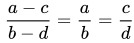
.